China News Service: KuWork beta puts AI alongside people
 KuWork
AI office tools are moving from conversational assistance toward automated execution. KuWork focuses on coordinating existing systems and advancing business work while keeping key decisions with people.
Interest in AI productivity tools remained strong in the first half of 2026. IDC data shows China’s enterprise AI agent market growing from CNY 21.2 billion in 2025 to CNY 44.9 billion in 2026. More than 20 new products entered the market behind that doubling. The industry shifted from early-year expectations of AI autonomously operating office software to leading collaboration vendors embedding AI in core workflows in the second quarter. China’s AI productivity market rapidly evolved from conversational assistance to automated execution.
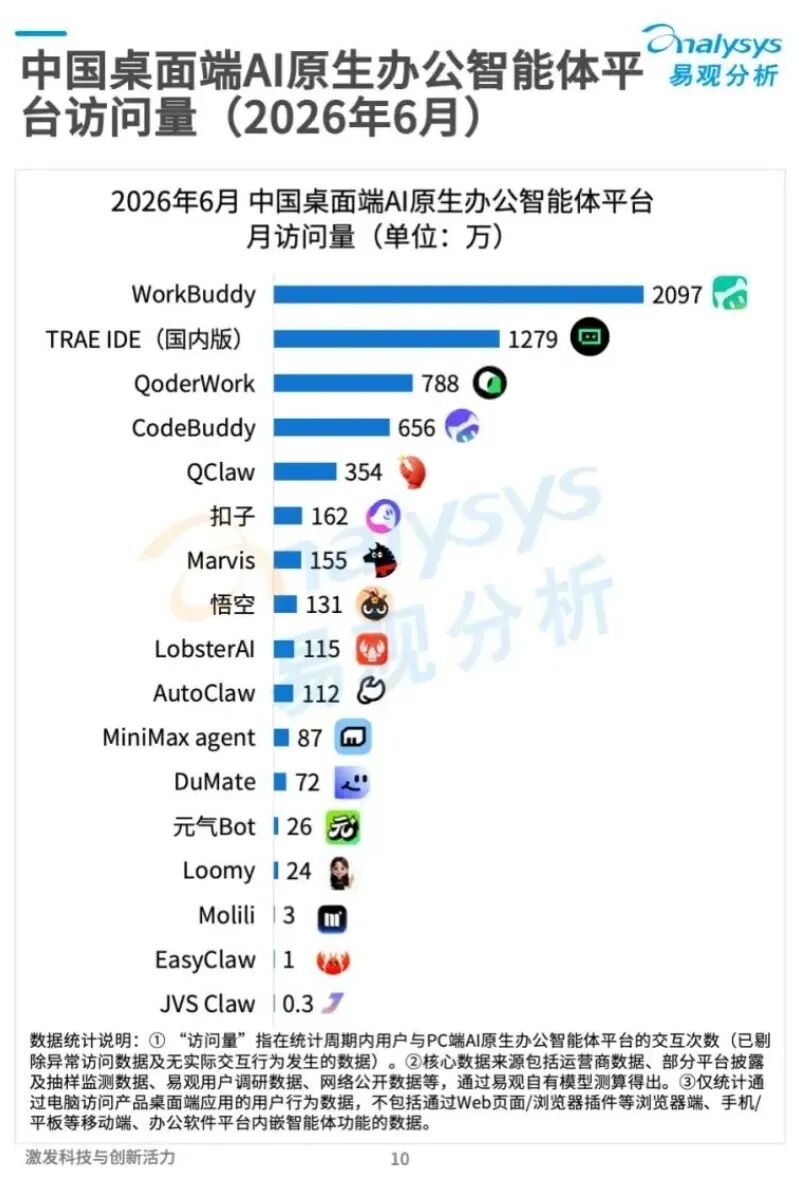
Products are becoming more complex while buyers grow more practical: do these products actually help companies finish the work?
“Finished” means more than writing a weekly report, finding a data point, or generating a slide deck. It meanswork moving across departments and systems from start to finish, without people switching tools, relaying messages, or picking up the pieces.
Viewed against that standard, the market looks less convincing.
1. Why three common approaches to workplace AI fall short
From its long-term observation of the AI productivity market, Kuailu Technology sees many products following three fundamental paths.
The first is the personal conversational AI assistant, which helps with thinking but not implementation. This is the most widespread form of workplace AI, and it can draft proposals, summarize, and research efficiently.
But its output stays inside a chat window. After creating content with AI, employees must still open the OA system to request approval, open ERP to enter orders, and save files in the right project folder. AI handles the thinking while people still do the execution, leaving AI at the surface.
The second is AI embedded in SaaS, which mostly remains within system silos. Ask how many times a customer has been contacted recently, and AI can find the answer in CRM data.
Its advantage is understanding that system’s data. Its limit is understanding only that system. Ask how far an order has progressed in production, and it cannot answer because the production data is in ERP, not CRM.
Some vendors try to integrate external systems through iPaaS, but connecting heterogeneous systems is costly, and permissions and data models are hard to align fully. Even with integrations, smooth end-to-end business execution remains difficult. AI stays within one system’s walls.
The third is desktop automation AI, which looks fully autonomous but performs only surface-level actions. This is currently the hottest direction, evolving from “Lobster” wrappers and moving from chat to the desktop. You set a goal and AI operates the computer—opening a browser, filling forms, and creating files. It looks the most like getting work done.
Look closely, though, and it operates your desktop or one application, not all your systems. It may complete an expense form without knowing which financial account applies, how many approval levels are required, or how much budget remains. It appears to replace manual actions but does not understand enterprise business rules, so complex cross-system work remains beyond it.
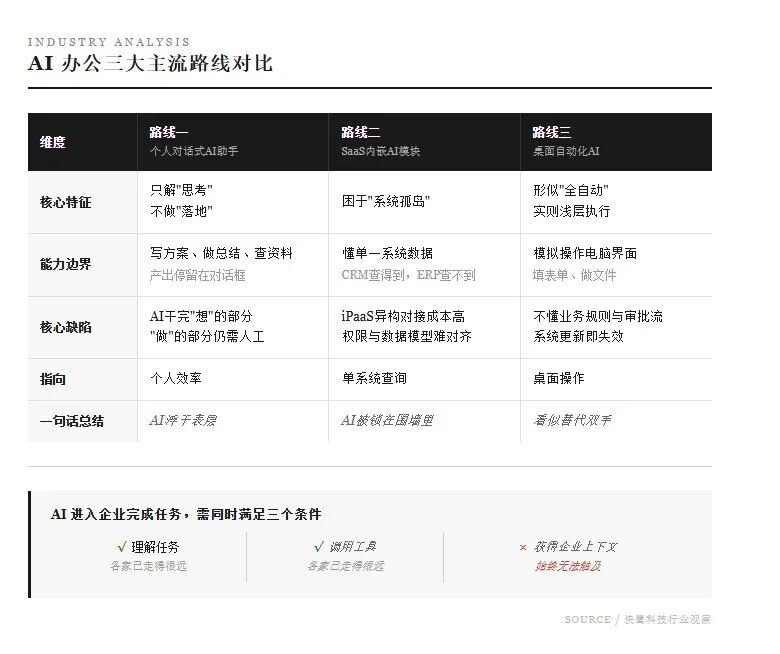
These paths address individual productivity, single-system queries, and desktop actions. To complete tasks inside an organization, AI must understand tasks, call tools, and access enterprise context at the same time.
Vendors have made substantial progress on the first two, but enterprise context remains out of reach.
2. The next step: AI working with your systems
Changes in major vendors’ organizational strategies offer a clue.
From early August, Qianwen Office completed an iteration integrating QoderWork, MuleRun, and Wukong to address desktop operation, agent execution, and organizational permissions respectively.
Their combination also demonstrates that organizational permissions and enterprise data context are essential alongside model capability and execution.
From Sam Altman’s claim that old SaaS is dead to this wave of major vendor entries, companies have returned to opening software CLIs and connecting systems. After the technological excitement comes practical implementation: software becomes infrastructure that works closely with AI rather than being replaced.
Kuailu Technology says it anticipated this trend at the start of the year. Its general manager of product, Dong Ting, expressed this view at several closed-door meetings:“Everyone is trying to replace things, but that may be the wrong path. ERP, CRM, OA, and MES are core assets companies have spent ten years building. Their business rules, approval processes, and customer data are worth more than any general-purpose model.”
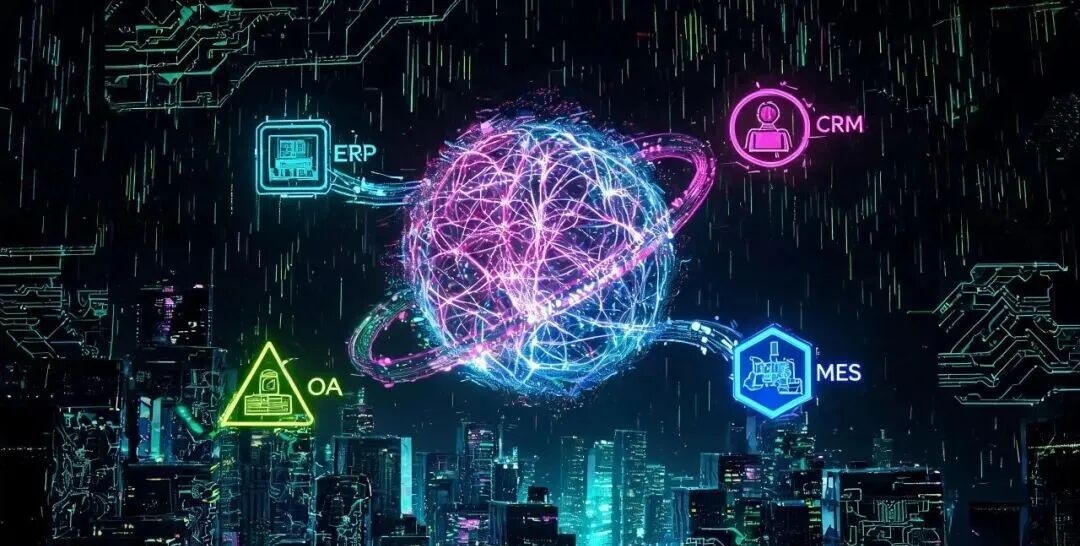
The first step in bringing AI into a business is connecting it to the systems already in place, so work can move between them.
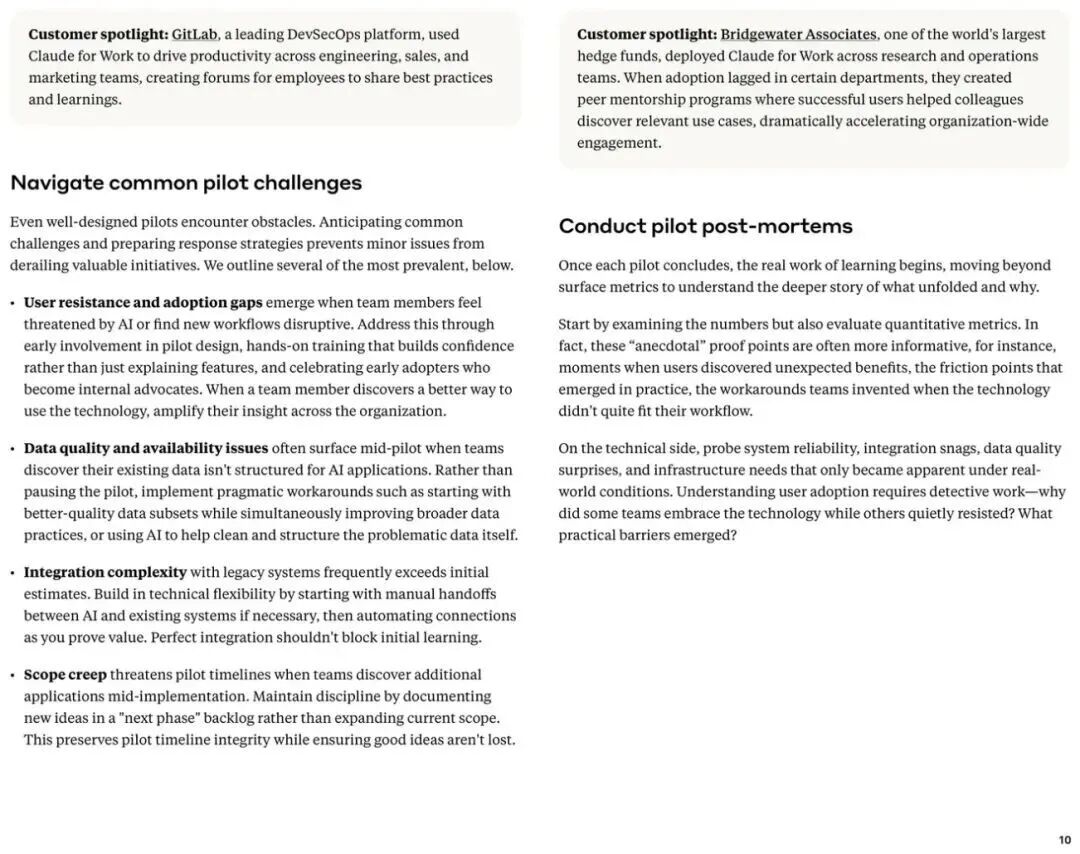
This is more than repairing old tools in a new era. Industry data points in the same direction. IDC identifies enterprise infrastructure and data readiness, rather than model capability, as the real limits to AI at scale. Anthropic’s Enterprise AI Transformation Guide notes that integration with legacy systems is often more complex than expected, requiring companies to address data availability and integration in their existing environments first. In other words, practical enterprise adoption depends on whether existing systems connect, not simply how smart the model is.
But this is hard. A chatbot can launch in two weeks. AI embedded in SaaS adds a feature. A desktop operation tool looks technically impressive. Each adds an AI layer to an existing product.
Making ERP, CRM, OA, and MES coordinate, and letting AI advance work across them, is a different challenge. AI must understand each system’s data structures and business logic, the organization’s approval and permission architecture, and differences in industry workflows.Solving this takes industry knowledge and years of engineering experience, not just technology.
So most choose the easier path.
3. Enterprise services require a long-term commitment
Kuailu Technology’s focus on making AI work across systems was a deliberate choice.
Over the past two or three decades, software companies have claimed specific territories: Beisen in recruitment, DingTalk and Feishu in messaging. Vertical products have been the industry’s mainstream approach. Kuailu started differently: understanding relationships between departments and using an internally developed, comprehensive product suite to cover core office scenarios, rather than building a single-purpose tool connected to others’ systems.
After seven years and CNY 200 million invested in in-house development, Kuailu’s portfolio covers core needs in office work, finance, HR, administration, purchasing, CRM, instant messaging, and meetings, with integrations to other vendors’ systems.
It is rare in the software industry for one internal team to develop such broad business coverage.This lays the groundwork for coordination: connected data, a shared permission architecture, and consistent business rules allow AI to move work smoothly between systems.
This comprehensive portfolio provides the foundation for Kuailu’s coordinated AI. When AI needs cross-system data, it does not need to connect APIs from seven or eight vendors or handle seven or eight data formats. Data structures, permission models, and approval logic are unified. A unified digital foundation for company operations is a prerequisite for AI to understand how the enterprise works.
As major vendors enter AI for work, competition extends beyond technology to industry understanding. Kuailu remains rooted in enterprise services, using one benchmark customer to understand a segment deeply. Experience serving a thousand customers across more than 30 industries provides practical material for understanding scenarios. In textiles, manufacturing, healthcare, and other industries, differences from management to execution are captured through detailed customer feedback.
Enterprise services reward sustained effort. For AI to truly enter an organization, it must understand its internal knowledge—**business rules, approval processes, customer data, and supplier relationships.** That understanding is built gradually through practical industry experience.
4. Connect the systems and take work through to completion
When AI truly enters business systems, it can unlock meaningful gains in human productivity.
For individuals, AI broadens access to technology and knowledge. People can move beyond a single function to complete varied tasks independently. **In enterprise work, AI gives one person capabilities across functions and departments, making that person a unit capable of combining scattered tasks into a complete delivery.** For everyday processes that constrain creativity, users can state a need in one sentence and let AI agents work around the clock.
Every AI interaction and project record adds to the company’s knowledge, giving AI more context to keep improving.
This is a new form of work and the next-generation approach to workplace AI Kuailu continues to explore. Its product KuWork—an AI work partner platform for growing enterprises—is currently in private beta.
Its positioning is clear: preserve existing enterprise systems and human roles while AI connects systems and advances business work. When a user states a goal, KuWork coordinates the most suitable AI across existing systems and returns the result.
People make the calls at key decision and review points.
Limited private beta spots available
Press and hold to scan and request access.

For example, an order administrator at a manufacturer enters orders in ERP, confirms customers in CRM, requests approval in OA, and notifies production in a group chat. One job means moving between four or five systems.
For this person, cross-system work is daily life. Once connected, AI can move work through these systems while the administrator confirms key checkpoints—a fundamental change.
On the future of work, Kuailu’s general manager of product, Dong Ting, says: “Give the work to AI and leave judgment to people. That is not conservative—it respects how companies actually work.”
As workplace AI moves from assisting content creation to coordinating business, companies may redefine productivity.
5. An AI partner that helps businesses get work done
We spoke with Dong Ting, general manager of product at Kuailu Technology, at the company’s office about AI at work. Here is the conversation.
Q: There is a lot of interest in workplace AI this year, with many new products. How does Kuailu see the market?
Dong Ting: We see three paths in the market. Some build desktop AI; others build assistants inside an ecosystem. Kuailu takes another path: keep existing enterprise systems and help them coordinate. After seven years building enterprise software and serving more than 1,000 customers, we understand the value of those systems.
Q: Everyone talks about AI taking over work. Is KuWork’s emphasis on preserving people’s roles and existing systems too conservative?
Dong Ting: Quite the opposite. We believe three things. First, AI should move work forward, not take over judgment. Second, executing a task autonomously is different from making decisions autonomously. Third, the more AI does for you, the more your judgment matters.
Q: What is Kuailu Technology’s biggest challenge in AI?
Dong Ting: Helping the market understand what we do. People tend to see AI as either a chatbot or a replacement. Our approach—connecting systems so people can focus on decisions—takes time to explain.
Q: Can KuWork connect to a company’s existing ERP, CRM, and other systems?
Dong Ting: Connecting existing enterprise systems is a basic design premise of KuWork. We connect between them to advance work, rather than asking companies to replace them.
Q: Data security is a major enterprise concern. How do you address it?
Dong Ting: It is a core investment area for Kuailu. We support private deployment, keeping data within the enterprise intranet, financial-grade encryption in transit and at rest, end-to-end monitoring, and intelligent alerts.
Q: Is AI suitable for small and medium businesses? Many see it as something for large companies.
Dong Ting: They are especially well suited. Growing enterprises often already have systems deployed, but coordination remains manual. That is exactly where AI adds the most value: helping systems coordinate without replacing them.
Q: Finally, what three things would you tell a company considering AI?
Dong Ting: First, do not replace systems that work well just for AI; they are core business assets. Second, the more AI does, the more your judgment matters. Give routine work to AI and keep key decisions with people. Third, start with one concrete job: find the most troublesome cross-system task and see whether there is a solution.
Put AI within reach of your whole team.
Connect expertise, enterprise knowledge, and real workflows with KuWork.