




Which Low-Code HR System Is the Best? Kuailu Cloud Solves Manufacturing Scheduling Woes with a 30-Day Free Trial!
"The workshop operates on a 'three-shift system'. It takes one day a week to schedule shifts, and during the month-end attendance check, missing just one overtime hour means rechecking all the data for the entire month. Attendance calculation alone accounts for 40% of my work." The complaint from Li, an HR professional in the manufacturing industry, echoes the voices of countless peers.
Zhang, an HR manager at a trading company, has even more specific troubles: "Sales commissions are calculated based on 'performance tiers + regional subsidies + payment collection rate'. Every month, I have to export performance data from CRM and payment records from the finance system, then manually apply formulas to calculate salaries for 100 sales staff—it takes 3 days. I also frequently receive complaints due to formula errors."
This is not an isolated phenomenon but a common dilemma for growing enterprises. Businesses across manufacturing, trading, service, and other sectors have vastly different HR management needs, and the "one-size-fits-all standardized templates" of traditional HR systems struggle to adapt to industry-specific requirements.

I. Industry Pain Points: The Dilemma of Traditional HR Systems' "One-Size-Fits-All" Approach
When adapting across industries, the limitations of traditional HR systems are fully exposed:
- Scheduling Pains in Manufacturing: Complex schedules like "three-shift systems" or "four-shift three-rotation systems" can only be adjusted manually. Piece-rate wages require manual matching of attendance and production data, leading to time-consuming and error-prone month-end calculations;
- Commission Chaos in Trading: Sales commission rules change frequently based on products, regions, and performance tiers. Traditional systems either do not support complex formulas or require manufacturers to customize rule changes, resulting in extremely low efficiency;
- Management Difficulties in Services: With multiple stores scattered across locations, each with different shift rules, attendance data needs manual aggregation. Salary calculations are often delayed, leading to a continuous decline in employee satisfaction.
- When industry characteristics meet a "one-size-fits-all" system, HR teams are trapped in a vicious cycle of "manual fixes", making digitalization a burden instead of an asset.
II. Kuailu Cloud's Breakthrough: Low-Code Adaptation Empowers HR to Control Rules Independently
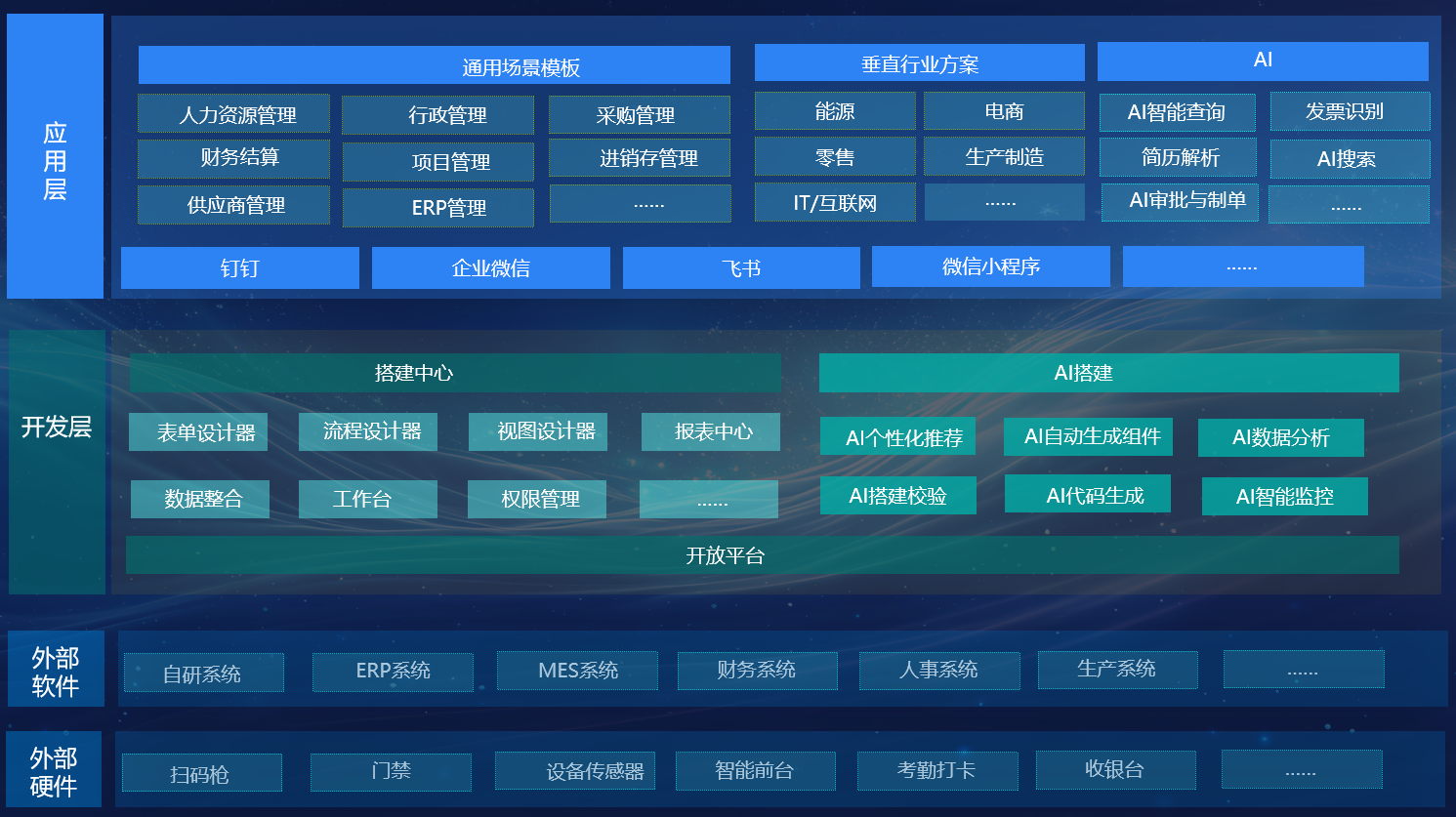
Built on a visual low-code platform, Kuailu Cloud breaks the rigid limitations of traditional systems. Without technical backgrounds, HR professionals can independently configure rules through simple drag-and-drop operations, accurately matching the needs of different industries.
1. Manufacturing: 150x Efficiency in Attendance Calculation, No More Overtime Reconciliation
Targeting the core challenge of "multi-shift scheduling + piece-rate correlation", Kuailu Cloud's low-code capabilities provide precise solutions:
- Customizable Multi-Shift Scheduling: Drag and drop to set rules for morning, afternoon, and other shifts, supporting hybrid modes of "fixed shifts + rotating shifts". Divide attendance groups by workshop/team, with automatic data aggregation;
- Linked Piece-Rate Data: API integration with production systems links clock-in data to output (e.g., 100 parts produced in 8 hours), synchronizing data to the payroll module with one click for piece-rate wage calculation;
- Real-Time Anomaly Alerts: Instant notifications for late arrivals, missed punches, etc., with online approval for supplementary punches to avoid month-end backlogs.
- Feedback from an auto parts enterprise: "Calculation time has been reduced from 3 days to 2 hours, and the error rate has dropped from 15% to 0." Adjusting scheduling rules takes only 10 minutes—far faster than the 1-2 week customization cycle of traditional manufacturers—saving over 5,000 yuan in costs.
2. Trading: Calculate Commissions for 100 Staff in 1 Hour, Instant Rule Updates
Solving the "HR nightmare" of commission calculation, low-code payroll configuration simplifies complex logic:
- Visual Formula Editor: Drag-and-drop editor supports complex rules like "Commission = (Performance - Base) × Tier Coefficient + Regional Subsidy × Payment Rate", with conditional logic (e.g., 10% coefficient increase for East China performance exceeding 1 million yuan);
- Automatic Data Integration: Performance data synced from CRM and payment records fetched from financial systems eliminate manual data export;
- Rapid Rule Updates: New policies such as quarterly bonuses take effect in 10 minutes without modifying underlying code.
- An HR manager at a trading company stated: "Calculating commissions for 100 staff has been cut from 3 days to 1 hour. Detailed reports resolve disputes." The system also supports procurement commissions and channel rebates, covering full business scenarios.
3. Services: Aggregate Multi-Store Data in 10 Minutes, On-Time Payroll Calculation
Multi-store management is easily handled through a "hierarchical model":
- Independent Store Configuration: Each store has its own attendance group with customized shift rules. Store managers access store-specific data, while headquarters views aggregated data, ensuring clear permission control;
- Multi-End Clock-In Synchronization: Coverage across mobile devices, attendance machines, and facial recognition, with real-time data transmission to headquarters;
- Rapid Anomaly Handling: Employee attendance anomalies are instantly pushed to store managers for approval.
- After adopting Kuailu Cloud, a chain catering enterprise reduced attendance aggregation time from 1 day to 10 minutes, advanced payroll calculation from the 5th to the 2nd of each month, and achieved a 100% on-time salary slip distribution rate, significantly improving operational efficiency.

III. Core Value: Independent Adaptation at 1/5 the Cost of Traditional Customization
The core advantages of Kuailu Cloud's low-code HR system lie in "no coding required, rapid adaptation, and independent adjustment":
- Four core capabilities—visual form designer, flexible process configuration, intelligent report analysis, and comprehensive permission management—empower HR to build systems independently;
- When growing enterprises' business needs change, HR can modify rules themselves without waiting for manufacturers or paying high customization fees, at only 1/5 the cost of traditional customization;
- One system covers everything from manufacturing shift scheduling and trading commissions to multi-store service management, eliminating the hassle of piecing together multiple tools.
- Traditional HR systems make industry adaptation a "problem", but Kuailu Cloud turns it into "simplicity" with low-code technology. Now that "adaptation difficulties" are resolved, how can Kuailu Cloud address growing enterprises' top concerns of "compliance + cost reduction"?